Written and reviewed by the DwellWatt Editorial Team · Last reviewed August 28, 2026 · How we research and review our guides
A typical full-size space heater uses 1,500 watts of electricity on its highest setting. If the heating element stays on continuously, that equals 1.5 kilowatt-hours (kWh) of electricity per hour.
At an electricity rate of $0.18 per kWh, a 1,500-watt heater costs about:
- $0.27 per hour
- $1.08 for four hours
- $2.16 for eight hours
- $64.80 per month when used eight hours a day for 30 days
Those figures are a full-power estimate, not a promise about your bill. A thermostat may cycle the heating element on and off after the room warms up, reducing actual consumption. Your local electricity rate can also move the result considerably.
Quick answer: A 1,500-watt space heater uses 1.5 kWh for every hour its heating element runs at full power. Multiply 1.5 by your electricity rate to find the hourly cost.
Space Heater Electricity Cost at a Glance
The table below uses $0.18 per kWh and assumes the heater draws its listed wattage continuously. This rounded rate is close to the U.S. residential year-to-date average of 18.11 cents per kWh for January through May 2026 reported by the U.S. Energy Information Administration. EIA figures for 2025 and 2026 were preliminary when this article was reviewed.
| Heater setting | Electricity per hour | Cost per hour | Cost at 4 hours/day | Cost at 8 hours/day | 30-day cost at 8 hours/day |
|---|---|---|---|---|---|
| 500 W | 0.50 kWh | $0.09 | $0.36 | $0.72 | $21.60 |
| 750 W | 0.75 kWh | $0.14 | $0.54 | $1.08 | $32.40 |
| 1,000 W | 1.00 kWh | $0.18 | $0.72 | $1.44 | $43.20 |
| 1,500 W | 1.50 kWh | $0.27 | $1.08 | $2.16 | $64.80 |
Your heater may not offer all four settings. Check the rating label or owner’s manual rather than assuming that “low” always means 750 watts.
How to Calculate Your Space Heater’s Cost
You only need three numbers:
- The heater’s wattage
- The number of hours the heating element runs
- Your electricity rate in dollars per kWh
The EIA defines one kilowatt-hour as 1,000 watts used for one hour. Using that relationship, apply this formula:
Cost = (watts ÷ 1,000) × hours × electricity rate
For a monthly estimate, add the number of days:
Monthly cost = (watts ÷ 1,000) × hours per day × days × electricity rate
Example: A 1,500-watt heater used four hours a day
Suppose the rate is $0.18 per kWh and the heater runs at full power for four hours:
- Convert watts to kilowatts: 1,500 ÷ 1,000 = 1.5 kW
- Calculate daily energy: 1.5 kW × 4 hours = 6 kWh
- Calculate daily cost: 6 kWh × $0.18 = $1.08
- Calculate a 30-day cost: $1.08 × 30 = $32.40
You can use the same method for almost any electric device. Our guide to calculating the electricity cost of any appliance explains each part of the formula in more detail.
Find the Right Electricity Rate on Your Bill
The national average is useful for an example, but it is not the best number for your home. Electricity prices vary by state, utility, plan, and time of day.
For a better estimate:
- Look for the per-kWh supply or generation charge on your bill.
- Add any per-kWh delivery charge that increases when you use more energy.
- Do not assign the utility’s fixed monthly customer charge to the heater, because you would normally pay that fee even if the heater stayed off.
- If you have a time-of-use plan, use the rate that applies during the hours when the heater operates.
- If your plan uses pricing tiers, consider whether the extra consumption will move into a higher-priced tier.
This small step often matters more than choosing between two electric heaters with the same wattage.
How Much Does a 1,500-Watt Space Heater Cost to Run?
The following estimates use $0.18 per kWh and continuous full-power operation.
| Daily use | Electricity per day | Cost per day | Electricity in 30 days | Cost in 30 days |
|---|---|---|---|---|
| 1 hour | 1.5 kWh | $0.27 | 45 kWh | $8.10 |
| 2 hours | 3 kWh | $0.54 | 90 kWh | $16.20 |
| 4 hours | 6 kWh | $1.08 | 180 kWh | $32.40 |
| 8 hours | 12 kWh | $2.16 | 360 kWh | $64.80 |
| 12 hours | 18 kWh | $3.24 | 540 kWh | $97.20 |
The eight-hour line is a cost calculation, not a recommendation to leave a portable heater on while sleeping or unattended. See the safety section below.
How the local rate changes the monthly cost
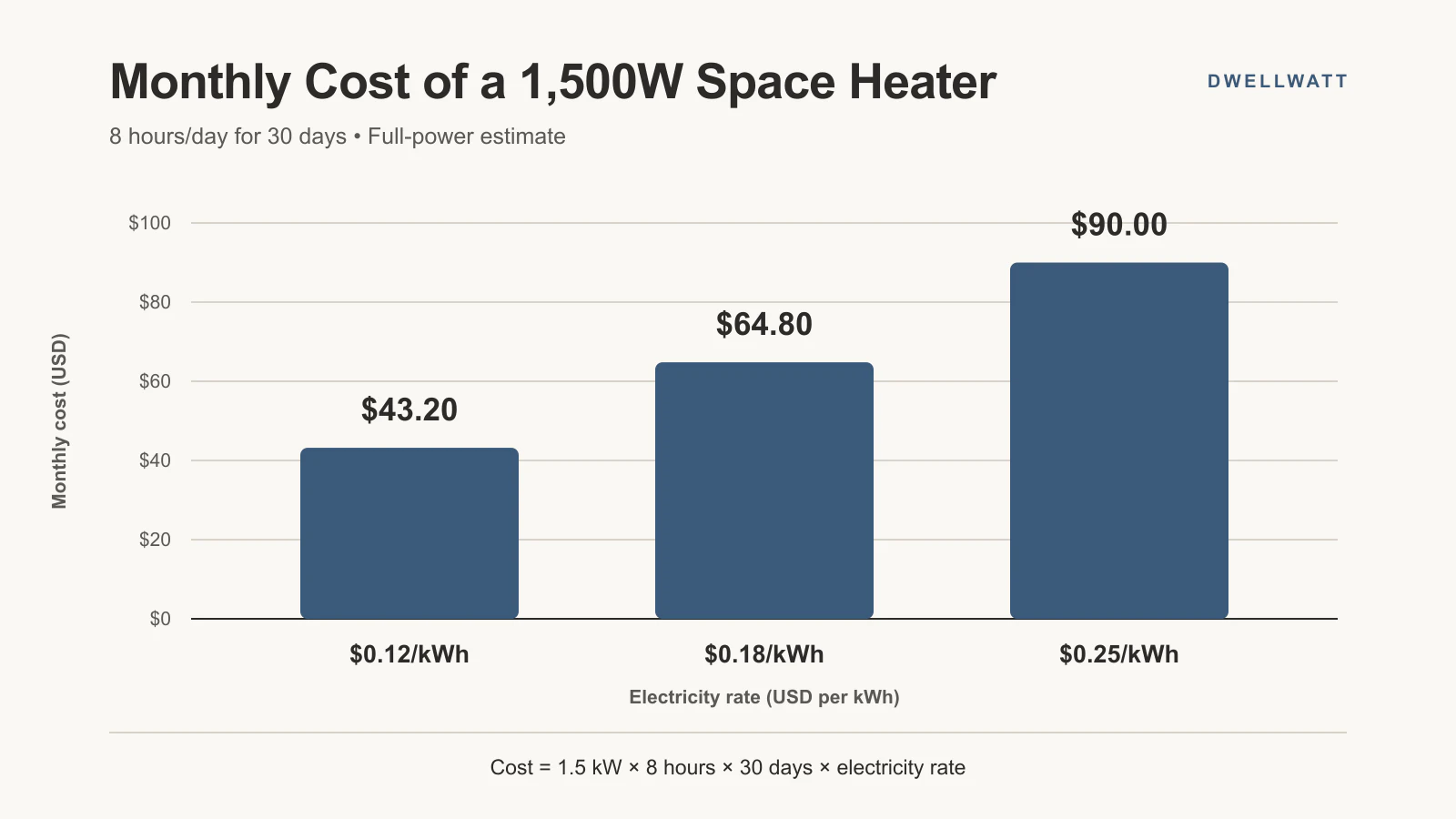
For the same 1,500-watt heater, price differences add up quickly:
| Electricity rate | 30 days at 4 hours/day | 30 days at 8 hours/day |
|---|---|---|
| $0.12/kWh | $21.60 | $43.20 |
| $0.18/kWh | $32.40 | $64.80 |
| $0.25/kWh | $45.00 | $90.00 |
These are illustrative rate scenarios. Replace them with the variable rate from your own utility bill.
Why Your Actual Cost May Be Lower—or Higher
The wattage calculation gives a reliable upper-bound estimate when the heater stays at that power level. Real-world use is more complicated.
The thermostat cycles the heating element
Once the room reaches the set temperature, many heaters switch the element off and turn it back on later. The percentage of the scheduled time that the element is actually heating is called its duty cycle.
Here is what that can mean for a 1,500-watt heater scheduled for eight hours a day at $0.18 per kWh:
| Heating-element duty cycle | Monthly electricity | Estimated 30-day cost |
|---|---|---|
| 100% | 360 kWh | $64.80 |
| 75% | 270 kWh | $48.60 |
| 50% | 180 kWh | $32.40 |
| 25% | 90 kWh | $16.20 |
These percentages are examples, not typical performance claims. Room size, insulation, drafts, outdoor temperature, thermostat setting, and heater placement all affect how often the element runs. The fan and controls may also draw a small amount of power when the element is off.
“Low” and “eco” do not mean the same thing on every heater
Some heaters reduce the element’s wattage on low. For example, a unit may use 750 watts on low and 1,500 watts on high. Others change fan behavior or cycle the heating element without using a fixed half-power setting.
An eco mode can save electricity by lowering the target temperature or shortening the element’s run time. It does not make electric resistance heat produce free energy. Check the manual for the actual wattage and control behavior.
A drafty room makes the heater work longer
A heater’s nameplate wattage does not increase because a room is poorly insulated. Instead, the heater stays on longer because heat escapes faster. Air leaks around windows and doors, high ceilings, open doorways, and very cold outdoor temperatures can all increase effective run time.
Do Ceramic, Infrared, and Oil-Filled Heaters Use Different Amounts of Electricity?
Not necessarily. If two electric resistance heaters draw the same wattage for the same amount of time, they use essentially the same amount of electricity.
The designs feel different because they deliver and store heat differently:
- Ceramic and fan-forced heaters warm and circulate room air quickly.
- Infrared heaters direct radiant heat toward people and nearby surfaces.
- Oil-filled radiators warm more slowly and continue releasing stored heat after the element cycles off.
Those differences can affect comfort, noise, thermostat cycling, and how long you choose to run the heater. They do not change the basic electricity calculation. A more expensive 1,500-watt model does not automatically cost less per full-power hour than a basic 1,500-watt model.
How Much Can a Space Heater Add to Your Electric Bill?
At $0.18 per kWh, one 1,500-watt heater running at full power for four hours every day adds about $32.40 over 30 days. Two heaters used on the same schedule would add about $64.80. At eight hours a day, one adds about $64.80, while two add about $129.60.
That simple multiplication is useful for spotting a winter bill increase. It also shows why heating several rooms with portable heaters can become expensive quickly.
Do not treat the two-heater example as electrical setup advice. A 1,500-watt heater at 120 volts draws about 12.5 amps, which is a heavy household load. Multiple high-draw appliances should not share an overloaded circuit. If a breaker trips or an outlet becomes hot, stop using the heater and have the situation checked by a qualified electrician.
Is a Space Heater Cheaper Than Central Heating?
Sometimes—but only under the right conditions.
A space heater may lower total heating costs when you:
- Spend most of your time in one room
- Use the heater only in that occupied space
- Turn down the central thermostat enough to reduce whole-home heating
- Keep the room reasonably well sealed and insulated
If the central system keeps running at the same setting, the space heater usually adds a new load instead of creating savings. Heating several rooms with separate portable heaters can also erase the advantage of zone heating.
The comparison depends on your central system, fuel price, climate, and home. A gas furnace, electric furnace, boiler, and heat pump have very different operating costs. The U.S. Department of Energy says today’s heat pumps can reduce heating electricity use by up to 75% compared with electric resistance systems in suitable applications because heat pumps move heat instead of generating it directly. That does not mean every household will save exactly 75%, but it explains why a space heater is rarely the best long-term solution for heating an entire home.
How to Reduce Space Heater Running Costs
The most effective strategy is to reduce the hours the heating element needs to run.
- Heat the occupied zone. Use a portable heater for the room you are actually using, not an open area that connects to the rest of the house.
- Choose the lowest comfortable setting. After the room warms up, a lower wattage or thermostat setting may maintain comfort with less energy.
- Stop drafts. Weatherstripping, caulk, and properly closed windows can slow heat loss.
- Keep doors closed when appropriate. A smaller enclosed area is usually easier to warm, provided this does not conflict with your HVAC system’s airflow requirements.
- Use the built-in thermostat. Let the heater cycle instead of running continuously on high.
- Compare total heating use. Savings only count if the space heater allows the main heating system to run less.
- Do not sacrifice safety to save a few cents. Do not use an unsupported external timer, extension cord, or power strip to automate the heater.
Space Heater Safety Checklist
Portable heaters are high-power appliances. The U.S. Consumer Product Safety Commission recommends these precautions:
- Keep the heater at least three feet away from curtains, bedding, furniture, and anything else that can burn.
- Place it on a stable, level surface where it is unlikely to be knocked over.
- Plug an electric heater directly into a wall outlet, never an extension cord or power strip.
- Never run the cord under a rug or carpet.
- Keep children and pets away from the heater.
- Turn the heater off when leaving the room and before going to sleep, as the CPSC also advises in its winter space-heater guidance.
- Stop using it if the plug, cord, outlet, or wall plate becomes hot, loose, damaged, or discolored.
- Follow the heater manufacturer’s instructions and recall notices.
When shopping, look for appropriate third-party safety certification plus overheat and tip-over protection. Safety features reduce risk, but they do not replace attentive use.
Frequently Asked Questions
How many kWh does a 1,500-watt space heater use in one hour?
It uses 1.5 kWh if the heating element remains at 1,500 watts for the full hour. If the thermostat switches the element off for part of that hour, actual consumption will be lower.
How much does it cost to run a 1,500-watt heater for one hour?
At $0.18 per kWh, the cost is about $0.27. At $0.12 per kWh, it is $0.18; at $0.25 per kWh, it is about $0.38.
How much does a space heater cost to run for eight hours?
A 1,500-watt heater costs $2.16 for eight hours at $0.18 per kWh if it runs continuously at full power. Thermostat cycling can reduce the actual cost. For safety, do not interpret an eight-hour calculation as advice to operate a portable heater while sleeping or unattended.
Does a thermostat reduce electricity use?
It can. A thermostat usually saves energy by turning the heating element off after the room reaches the set temperature. It does not necessarily reduce the power draw while the element is actively heating.
Do ceramic heaters use less electricity than oil-filled or infrared heaters?
Not simply because they are ceramic. Heaters with the same wattage and the same effective run time use approximately the same electricity. Design differences may change comfort and cycling behavior, which can change how long you run them.
Is a 750-watt setting half the cost of 1,500 watts?
Yes, if both settings run for the same amount of time and the 750-watt label reflects the heater’s actual power draw. At $0.18 per kWh, 750 watts costs about $0.14 per hour, while 1,500 watts costs $0.27 per hour before thermostat cycling.
Can I plug a space heater into a power strip or extension cord?
No. The CPSC advises plugging an electric portable heater directly into a wall outlet and never using a power strip or extension cord.
Is it safe to leave a space heater running overnight?
The CPSC advises turning portable heaters off before sleeping. Use the eight-hour examples in this article for cost comparison only, not as an overnight-use recommendation.
Next step
Use our appliance electricity cost guide to replace the example rate with the price on your utility bill. For another appliance that can run for many hours, compare the numbers in our dehumidifier electricity cost guide.
Methodology and Sources
All estimates use these formulas:
- Energy (kWh) = watts ÷ 1,000 × hours
- Cost = energy in kWh × electricity rate
Monthly examples assume 30 days. Unless a duty cycle is stated, the tables assume the heating element remains at the listed wattage for the full operating period. Costs were calculated using unrounded figures and then rounded to the nearest cent.
The $0.18-per-kWh example rate is intentionally rounded and should be replaced with the reader’s local variable rate. It is close to the EIA’s January–May 2026 U.S. residential average of 18.11 cents per kWh. The EIA also reported 18.44 cents per kWh for May 2026 alone. Both figures were preliminary when reviewed.
This article uses published specifications and arithmetic; DwellWatt did not claim laboratory testing of a particular heater.
Primary references:
- U.S. Energy Information Administration — Electric Power Monthly, Table 5.3
- U.S. Energy Information Administration — measuring electricity
- U.S. Consumer Product Safety Commission — portable heater safety guidance
- U.S. Department of Energy — heat pump systems
- Lasko — example 1,500-watt, 120-volt heater specifications
Last reviewed: August 28, 2026. Electricity rates and safety guidance can change; check your utility bill and the current instructions for your heater.