Written and reviewed by the DwellWatt Editorial Team · Last reviewed August 28, 2026 · How we research and review our guides
To estimate an appliance’s electricity cost, first calculate how many kilowatt-hours (kWh) it uses. Then multiply that energy use by the applicable usage rate on your utility bill.
Quick formula
Estimated energy (kWh) = average real input power (W) × operating time (hours) ÷ 1,000
Estimated cost = energy (kWh) × applicable usage rate ($/kWh)
If you already know the appliance’s kWh use—from an EnergyGuide label or a plug-in electricity meter—multiply that number directly by your rate.
This gives you a practical estimate of the appliance’s energy charge. Your exact bill may differ because fixed charges, taxes, tiered pricing, time-of-use rates, weather, settings, and equipment cycling can all affect the result.
In this article
- The Quick Formula
- What You Need Before You Calculate
- Step 1: Find the Appliance’s Energy Use
- Step 2: Convert Watts Into Kilowatt-Hours
- Step 3: Choose the Right Electricity Rate
- Step 4: Calculate the Final Cost — Worked Examples
- Why Your Actual Cost May Be Different
- How to Make Your Estimate More Accurate
- Appliance Electricity Cost Worksheet
- Frequently Asked Questions
- Next step
- Sources and Methodology
The Quick Formula
Electric utilities measure the energy you use in kilowatt-hours. One kilowatt equals 1,000 watts, and one kilowatt-hour is the energy used by one kilowatt operating for one hour, according to the U.S. Energy Information Administration.
Use these three steps when the appliance’s wattage reasonably represents its average real input power:
- Convert watts to kilowatts: watts ÷ 1,000
- Calculate energy use: kilowatts × hours used
- Calculate cost: kWh × electricity rate
For repeated use, calculate the period you actually want:
- Daily cost: (average input watts ÷ 1,000) × hours used per day × rate
- Monthly cost: daily kWh × days used in the month × rate
- Annual cost: annual kWh × rate
What Each Unit Means
| Unit | Meaning | What it tells you |
|---|---|---|
| W | Watts | The appliance’s power draw at a moment in time |
| kW | Kilowatts | Watts divided by 1,000 |
| kWh | Kilowatt-hours | Energy used over time |
| $/kWh | Dollars per kilowatt-hour | The price applied to electricity use |
Do not confuse kW with kWh. Kilowatts measure power; kilowatt-hours measure the energy that appears on your bill.
What You Need Before You Calculate
You need three pieces of information:
- The appliance’s wattage or measured kWh use
- How long or how often it operates
- Your applicable electricity rate in dollars per kWh
The quality of your estimate depends mostly on where those inputs come from.
Choose the Best Energy-Use Source
| Source | Best use | Main limitation |
|---|---|---|
| Nameplate or manual wattage | Quick estimate for a steady load | May show rated or maximum power rather than typical use |
| EnergyGuide annual kWh | Major appliances covered by the label | Based on standardized assumptions, not your household’s exact use |
| Plug-in electricity meter | Devices that cycle or change power | Must be compatible with the appliance and measured long enough |
| Utility or smart-home monitoring | Whole-home or circuit-level patterns | May not isolate one device accurately |
Step 1: Find the Appliance’s Energy Use
Check the Nameplate or Manufacturer Manual
Look for a label on the back, bottom, door frame, power adapter, or control panel. It may list input power in watts. The manufacturer’s manual or official specification page may also provide it.
Use the electrical input rating, not an output rating.
For example, a microwave’s advertised cooking output is not necessarily the same as the electricity it draws from the outlet.
If the label lists only volts and amps, multiplying them can provide a rough screening estimate for some equipment, but it may not equal the appliance’s normal real-world wattage.
Nameplate amperage may reflect a maximum. For a single-phase AC load, volts multiplied by amps gives apparent power in volt-amperes (VA), not necessarily real power in watts. Real watts equal volts × amps × power factor. For a DC load—or an AC load with a power factor of 1—volts × amps equals watts.
A measured watt or kWh value is usually more useful than estimating from volts and nameplate amps.
Read the EnergyGuide Label
The yellow EnergyGuide label on many major appliances shows estimated energy use and an estimated yearly operating cost. For an applicable electric appliance, look for the estimated yearly electricity use shown in kWh.
The Federal Trade Commission explains that the printed cost is based on typical use and a national average energy price, so your actual cost depends on your usage and local rate.
For a more personal estimate, use the label’s annual kWh figure and multiply it by the rate from your own bill:
EnergyGuide formula
Estimated annual cost = EnergyGuide annual kWh × your applicable $/kWh rate
EnergyGuide and ENERGY STAR are not the same thing. EnergyGuide provides energy-use and cost information for comparison. ENERGY STAR identifies products that meet energy-efficiency criteria set by the U.S. Environmental Protection Agency.
Use a Plug-In Electricity Meter
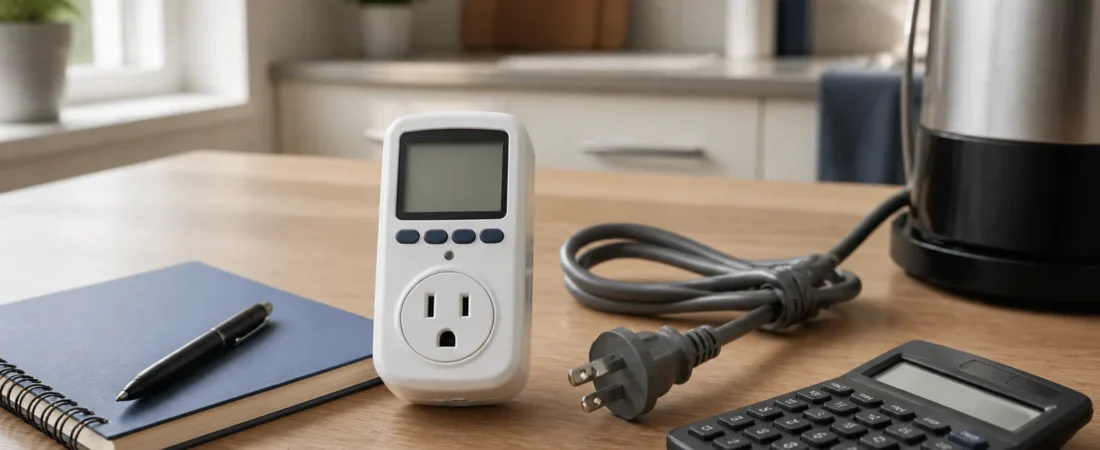
A compatible plug-in meter can measure real electricity use over time.
This is especially helpful for refrigerators, entertainment equipment, office electronics, and other devices whose power draw changes.
Measure for a representative period. A few minutes may be enough for a stable lamp, but an appliance that cycles may need several days.
The Department of Energy’s guidance on measuring standby power notes that fluctuating consumption should be measured over time and averaged rather than read at one instant.
Use a plug-in meter only when its manufacturer expressly rates it for the outlet, voltage, current, power, appliance, and startup load. Never improvise an adapter or open an electrical panel. Hardwired, circuit-level, and 240-volt measurements require equipment designed for that application and may require a qualified electrician.
Step 2: Convert Watts Into Kilowatt-Hours
Suppose a device is rated at 100 watts and runs for three hours:
- 100 W ÷ 1,000 = 0.1 kW
- 0.1 kW × 3 hours = 0.3 kWh
The device used an estimated 0.3 kWh during those three hours. To convert that energy into cost, multiply it by your electricity rate.
If the device uses different power levels, calculate each period separately or use measured kWh for the full period.
Step 3: Choose the Right Electricity Rate
Your bill may show one price per kWh or separate per-kWh charges for electricity supply and delivery.
Use the charges that change when electricity consumption changes. If supply, delivery, fuel adjustments, riders, or taxes are charged per kWh, include the applicable variable components rather than treating them as fixed. If both supply and delivery have usage-based rates, include both.
Avoid dividing the entire bill by total kWh without understanding the result. That “effective rate” can include fixed customer charges, taxes, credits, and other items that may not change when you run one appliance less.
Tiered and Time-of-Use Rates
Some utilities change the per-kWh price based on how much electricity you use, the season, or the time of day. The Department of Energy describes energy charges that can vary by time of use and season, along with fixed and demand charges. Public residential examples include SMUD’s time-based rates and LADWP’s tiered rates.
For a time-of-use plan, calculate every price period separately:
Time-of-use formula
Total cost = sum of (kWh in each period × that period’s rate)
For a tiered plan, allocate the appliance’s additional kWh across any tiers reached by the household’s total consumption. Some residential plans also include a demand or capacity charge based on peak kW; when that applies, a kWh-only formula will not capture the full possible effect.
Use your utility’s current tariff or bill rather than a national average. The EIA notes that electricity prices vary by locality.
Step 4: Calculate the Final Cost — Worked Examples
Every number below is illustrative. Each example uses a hypothetical electricity rate of $0.17 per kWh. Replace it with the rate that applies to your home.
Example 1: A Steady 10-Watt LED Lamp
Assume a 10-watt lamp operates five hours per day for 30 days.
- 10 W ÷ 1,000 = 0.01 kW
- 0.01 kW × 5 hours = 0.05 kWh per day
- 0.05 kWh × 30 days = 1.5 kWh per month
- 1.5 kWh × $0.17/kWh = $0.26 per month, rounded
This method works well when the power draw is steady and the operating time is known.
Example 2: A Microwave With a Known Input Wattage
Assume the microwave’s electrical input is 1,200 watts and it runs for 10 minutes per day. Convert those 10 minutes to hours inside the calculation so rounding happens only at the end.
- 1,200 W ÷ 1,000 = 1.2 kW
- 1.2 kW × (10 ÷ 60) hours = 0.20 kWh per day
- 0.20 kWh × 30 days = about 6.0 kWh per month
- 6.0 kWh × $0.17/kWh = $1.02 per month
Use the input wattage from the nameplate or manual—not the microwave’s cooking-output number.
Example 3: An Appliance With EnergyGuide Annual Use
Assume an EnergyGuide label lists 500 kWh per year.
- 500 kWh × $0.17/kWh = $85 per year
- $85 ÷ 12 = about $7.08 per month, averaged across the year
This recalculates the label’s energy estimate using the household’s own rate. Actual use can still change with settings, household habits, climate, and operating conditions.
Example 4: A Cycling Appliance Measured for Three Days
Assume a compatible plug-in meter records 4.8 kWh over three representative days.
- 4.8 kWh ÷ 3 days = 1.6 kWh per day
- 1.6 kWh × 30 days = 48 kWh per month
- 48 kWh × $0.17/kWh = $8.16 per month
This method captures compressor cycles and standby periods that a single nameplate-wattage calculation can miss. A longer test is better when weather or usage varies substantially.
Example 5: An Appliance on a Time-of-Use Plan
Assume an appliance uses 1.2 kWh per cycle and runs 12 times in a month: eight cycles at an off-peak rate of $0.12/kWh and four cycles at an on-peak rate of $0.30/kWh.
- Off-peak: 8 × 1.2 kWh × $0.12/kWh = $1.15
- On-peak: 4 × 1.2 kWh × $0.30/kWh = $1.44
- Estimated monthly energy cost: $2.59
The same number of cycles can have a different cost depending on when they occur.
Why Your Actual Cost May Be Different
The formula is straightforward, but the inputs are rarely perfect.
Cycling and Variable-Speed Operation
Refrigerators, air conditioners, heat pumps, dehumidifiers, and other thermostatically controlled equipment turn components on and off. Variable-speed equipment can also change power draw continuously.
Multiplying maximum wattage by every hour the appliance is switched on may overestimate energy use. If you have a reasonable duty-cycle estimate, use:
Duty-cycle formula
Estimated kWh = rated kW × elapsed hours × duty-cycle fraction
A 30% duty cycle is written as 0.30. Because the fraction can change with weather, settings, and load, a multi-day kWh measurement is usually more reliable than assuming a duty cycle.
Standby Power
Some products continue to use electricity while waiting for a remote signal, maintaining a network connection, displaying a clock, or powering an external adapter. The DOE calls this standby power. To estimate it, use the same formula with the measured standby wattage and the hours spent in that mode.
For example, a steady 3-watt standby load operating all year would use:
Standby example
(3 W ÷ 1,000) × 24 hours × 365 days = 26.28 kWh per year
At the illustrative rate of $0.17/kWh, that equals about $4.47 per year.
Settings, Climate, and Household Habits
Thermostat settings, room temperature, filter condition, load size, cooking time, wash cycle, door openings, and occupancy can all change energy use. Treat estimates as a range when those variables are uncertain.
Fixed Charges, Taxes, and Credits
Reducing appliance use may lower usage-based charges without changing a fixed monthly customer charge. Taxes, minimum bills, fuel adjustments, solar credits, and other bill items can also prevent the calculated appliance cost from matching the exact change in the total bill.
How to Make Your Estimate More Accurate
- Use the rate from your current utility bill or tariff.
- Add separate usage-based supply and delivery rates when both apply.
- Measure cycling equipment for several representative days.
- Separate on-peak and off-peak use under a time-of-use plan.
- Include standby time and different operating modes when they matter.
- Use annual kWh from an EnergyGuide label instead of maximum wattage when appropriate.
- Write down every assumption so you can update the estimate later.
Appliance Electricity Cost Worksheet
Copy this worksheet for any device:
- Appliance:
- Source of wattage or kWh:
- Watts or measured kWh:
- Hours per use or test period:
- Uses or days in the target period:
- Electricity rate:
- Estimated kWh:
- Estimated cost:
- Assumptions and limitations:
Frequently Asked Questions
How many kWh is 1,000 watts used for one hour?
One thousand watts equals one kilowatt. Used continuously for one hour, it equals 1 kWh.
Does a higher-wattage appliance always cost more per month?
No. Monthly cost depends on both power and operating time. A high-wattage appliance used briefly may consume less energy than a lower-wattage device that runs continuously.
Can I use the wattage printed on the appliance?
Yes, as a starting estimate. Check whether the number represents input power, maximum power, or a typical operating value. For equipment that cycles or changes speed, measured kWh or an EnergyGuide annual-use figure is usually more informative.
Why is my result different from the EnergyGuide cost?
The printed EnergyGuide cost uses standardized assumptions and a national average energy price. Recalculating the label’s kWh with your own electricity rate makes the cost estimate more relevant to your home, but your usage may still differ from the test assumptions.
Should I include my utility’s fixed monthly charge?
Usually not when estimating the additional cost of one appliance, because a fixed charge generally does not change with that appliance’s energy use. If your goal is to allocate the entire household bill among devices, state clearly that you are using a different method.
Can I use a plug-in meter with every appliance?
No. Use one only with compatible plug-in equipment and stay within the manufacturer’s ratings for the outlet, voltage, current, power, appliance, and startup load. Hardwired, circuit-level, and 240-volt measurements require equipment designed for the application and may require a qualified electrician.
Next step
Estimate a specific device with the same method: see how much a space heater costs to run and how much a dehumidifier costs to run.
Sources and Methodology
This guide follows DwellWatt’s Editorial Policy. All worked examples are illustrative, use a hypothetical rate, and show each calculation so readers can replace the assumptions with their own information.
Primary references, accessed August 24, 2026:
- U.S. Energy Information Administration: Measuring Electricity
- U.S. Energy Information Administration: Electricity Prices and Factors Affecting Prices
- Federal Trade Commission: How To Use the EnergyGuide Label
- U.S. Department of Energy: Measuring Standby Power
- U.S. Department of Energy: Evaluating Your Utility Rate Options
- SMUD: Time-of-Day Rate FAQs
- Los Angeles Department of Water and Power: Residential Electric Rates
Estimates are educational and are not a substitute for manufacturer instructions, utility tariffs, or professional electrical advice. See the DwellWatt Disclaimer for additional limitations. To report a correction, contact DwellWatt.