
Rates and schedules checked September 12, 2026 · How we research our guides.
Cover: AI-generated editorial illustration; not a real customer bill or an appliance test.
Quick answer: Electricity is cheaper at night only if your rate plan gives those hours a lower price. On an all-day flat rate, moving the same electricity use to midnight does not create a discount. On a time-of-use plan, it can help—but the cheapest window might include morning hours or even the middle of the day.
Delaying a load of laundry sounds like an easy way to save. The missing detail is your plan: a neighbor's cheap hours may not be yours, even if you share the same utility.
Before changing your routine, find your rate schedule and compare the prices that actually apply to your account. This guide walks you through that check, shows real U.S. examples, and calculates what shifting one hypothetical load would save. You do not need to buy a smart plug or sign up for a new plan to begin.
First, find out which kind of electricity rate you have
The name of your utility is not enough. Look for the plan name or rate code in your bill or online account.
On small screens, scroll the table sideways to see all columns.
| Rate type | Does the time of day change your price? | What to check |
|---|---|---|
| All-day flat rate | No, not just because the clock changes | Whether rates still vary by season, usage tier, or billing period |
| Time-of-use or time-of-day | Yes, according to a published schedule | Peak, off-peak, and any mid-peak or super off-peak hours |
| Hourly or dynamic pricing | Yes, with prices that can change from hour to hour | Current prices and the program's billing rules—not a permanent “cheap night” window |
For example, SMUD offers both time-of-day and fixed-rate options. A fixed rate can still differ between summer and winter; “fixed” does not necessarily mean unchanged forever.
By contrast, ComEd's Hourly Pricing program bases electricity supply prices on hourly market prices. That is different from a predictable time-of-use schedule, and savings are not guaranteed.
A smart meter is not proof that you pay time-of-use rates. Check the plan on your account, not just the equipment outside your home.
How to check your off-peak hours in three steps
1. Copy the exact plan name from your account
Look under “rate schedule,” “pricing plan,” or a similar section. A short code such as E-TOU-C matters: another plan from the same utility can have different hours.
Use the utility's official website to find that exact schedule. Check the effective date and confirm that it is a residential plan available to your account. A search result about last year's rates, business service, or a special EV plan may give you the wrong answer.
If the bill is unclear, ask customer service: “What rate plan am I currently on, and do any of my per-kWh charges change by time of day?”
2. Check the season, day, and entire operating window
Write down the cheapest hours for weekdays and weekends separately. Then check the utility's holiday calendar and seasonal changeover dates.
Do not assume that starting an appliance in a cheap period locks in that price for the whole cycle. Electricity used after a rate boundary can fall into the next price period. Leave enough room for the cycle to finish, using the schedule's stated time basis.
For instance, SMUD explains that usage is billed in the period when it occurs. Its summer schedule also differs from its October-through-May schedule.
3. Compare the relevant charges, not just one headline number
An electricity bill can separate supply or generation from delivery. Check which charges change with the hour, and which stay the same. Con Edison's time-of-use page, for example, separates delivery and supply information and notes that listed prices exclude surcharges.
Dividing your total bill by your kWh gives a useful average, but it is not necessarily the price of using one more kWh at 10 p.m. Fixed monthly fees are part of that average, yet moving a load usually does not remove them.
If this is unfamiliar, start with our guide to calculating appliance electricity costs.
Real examples: “after dinner” is not always cheapest
These are selected plans, not statewide rules. Schedules were checked on September 12, 2026; confirm your current tariff before relying on them.
On small screens, scroll the table sideways to see all columns.
| Utility and selected plan | Schedule detail | Practical takeaway |
|---|---|---|
| PG&E E-TOU-C | Peak pricing is 4–9 p.m. every day; other hours are off-peak | Waiting until after 9 p.m. avoids this plan's peak window |
| SCE TOU-D-4-9PM, winter (October–May) | Super off-peak hours are 8 a.m.–4 p.m.; overnight hours are off-peak | The lowest price period is daytime, not overnight |
| SMUD Time-of-Day (5–8 p.m.), summer (June–September) | Weekday off-peak runs midnight–noon; 8 p.m.–midnight is mid-peak | After 8 p.m. is cheaper than peak, but morning offers the lowest period too |
Sources: PG&E time-of-use plans, SCE time-of-use plans, and SMUD schedules.
Notice how much the plan name matters. PG&E's E-TOU-D has a different peak window: 5–8 p.m. on weekdays, with weekends and most holidays off-peak. Borrowing the schedule from another customer could lead you to shift a task to the wrong time.
How much can shifting a load actually save?
For a simple time-of-use comparison on the same plan:
Savings = shifted kWh × (higher rate − lower rate)
Suppose a task uses 3 kWh. This is an illustrative energy amount, not a claim about a typical dishwasher or dryer.
Using SMUD's published 2026 summer weekday rates:
On small screens, scroll the table sideways to see all columns.
| When all 3 kWh are used | Rate | Electricity usage charge |
|---|---|---|
| 5–8 p.m.: peak | $0.3765/kWh | $1.13 |
| 8 p.m.–midnight: mid-peak | $0.2139/kWh | $0.64 |
| Midnight–noon: off-peak | $0.1550/kWh | $0.47 |
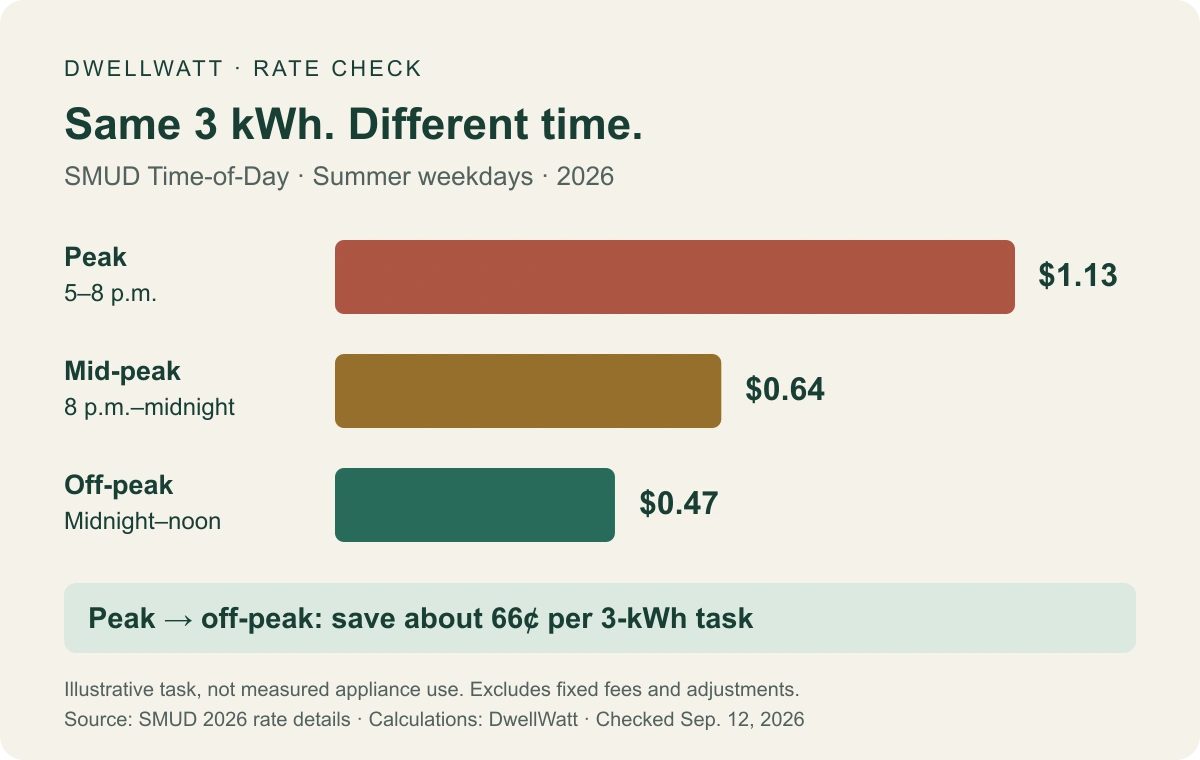
DwellWatt calculation using the cited rates. Same 3 kWh in each case; excludes fixed fees, taxes, and other adjustments. Values are rounded only after calculation.
Moving the entire task from peak to off-peak saves:
3 × ($0.3765 − $0.1550) = $0.6645, or about 66 cents.
Do that 12 times in a month and the estimated usage-charge savings are $7.97, calculated from the unrounded amount. That is useful, but it is not a promise to cut your entire bill by a large percentage.
On an illustrative all-day rate of $0.20/kWh, the same task would cost $0.60 at either time. Moving it changes nothing; reducing its energy use still helps.
If you do not know your appliance's kWh, use measured consumption when available or a clearly labeled estimate. Nameplate watts multiplied by the full cycle time can overstate consumption for equipment that cycles on and off.
What should you move—and what should you leave alone?
Start with one flexible task that uses enough electricity to make the rate difference worthwhile. Moving a few minutes of phone charging is not the same opportunity as shifting several kWh.
- Laundry: Choose a lower-cost window when you are awake and at home. A weekend morning may fit better than midnight, depending on your plan.
- Dishwashing: Check the expected cycle length and the manufacturer's operating instructions. Choose a window that works safely for your household; do not assume every delay-start setting lands entirely off-peak.
- EV charging: If you already have a properly installed charger, check its scheduling features and your account's exact rate. A special EV rate may require enrollment; owning an EV does not automatically apply every available discount.
- Heating and cooling: Avoid aggressive changes that compromise comfort or health. Compare the whole day's consumption before assuming that extra heating or cooling in cheap hours pays off.
Do not trade safety for a few cents. NIH's dryer fire-safety guidance advises switching the dryer off before sleeping or leaving home. A cheap overnight window is not a reason to ignore that advice.
Leave refrigerators and essential medical equipment operating as required. This is about rescheduling flexible use, not interrupting equipment your household depends on.
Should you switch to a time-of-use plan?
Shifting a task on your current plan and changing plans are two different decisions.
A lower overnight rate can come with a higher daytime rate. If your household uses a lot of electricity during the expensive window, a few shifted loads may not offset the increase elsewhere.
Before switching, use the utility's plan-comparison tool, if available, with a full year of your usage history. PG&E offers an account-based rate comparison through its time-of-use information page. Treat projected savings as an estimate, especially if your household schedule or equipment is changing.
Compare the complete annual bill, including fixed charges, seasonal differences, applicable credits, and any enrollment or switching conditions. If you have solar, battery storage, or demand charges, a simple two-rate calculation may miss important costs or credits.
If your main concern is a recent spike rather than the best schedule, our high electric bill checklist can help you separate higher prices from higher consumption.
Common questions
Is electricity always cheaper after 9 p.m.?
No. That timing works for avoiding peak hours on some plans, but it is not a national rule. Check the plan code, season, and day. “Less expensive than peak” also does not necessarily mean “the lowest price.”
Are weekends always off-peak?
No. Some schedules make weekends off-peak, while others still have expensive hours. PG&E E-TOU-C, for example, has its 4–9 p.m. peak window every day.
Will changing the time I use appliances lower my kWh?
Not by itself. Running an unchanged task with the same energy requirement at a different hour shifts when you use electricity. It can lower the cost on a qualifying rate plan without reducing the kWh. Using less electricity is a separate way to save.
Your next step: write down one useful number
Find your plan's higher and lower per-kWh prices, subtract them, and multiply by the kWh you can realistically move. If the savings justify the change, try one safe, convenient scheduling adjustment.
The best time to use electricity is not automatically “at night.” It is the lower-cost window on your plan that also works for your household.
Prepared by the DwellWatt Editorial Team. Rates and schedules checked September 12, 2026. Examples are calculations, not measurements of a tested appliance or a guarantee of savings. Your current utility tariff and account terms govern your bill. See our editorial policy for our approach to sourcing and review.