By DwellWatt Editorial Team · Sources reviewed September 3, 2026
A space heater can cost less than central heating when it keeps one occupied room comfortable while you safely reduce heating elsewhere. But it is not automatically cheaper. A heat pump or gas furnace may produce heat for less money. The deciding factor is whether the central-heating cost you avoid exceeds the electricity cost you add.
Picture a workday spent in a chilly home office. Raising the main thermostat warms rooms you are not using. A portable heater seems like the obvious alternative—but “smaller heater” and “smaller bill” are not the same thing.
This guide separates two questions: which system produces heat more cheaply, and whether heating a smaller area can lower your total cost.
Start With the Heating System You Already Have
“Central heat” describes how heat reaches your rooms, not necessarily how it is produced. Check your equipment documentation or ask your HVAC service provider whether you have a gas furnace, electric-resistance furnace, heat pump, or another system.
A portable electric-resistance heater converts electricity into heat in the room. An electric furnace uses the same basic heating principle, but distributes heat through ducts. The Department of Energy’s HVAC guide explains that electric-resistance equipment converts essentially all its electricity to heat; duct losses are a separate issue.
A heat pump works differently: it transfers heat. Its coefficient of performance, or COP, compares heat output with electricity input. A COP of 3 means 1 kWh of electricity provides 3 kWh of heat under those operating conditions. The DOE Energy Saver guide explains this heat-moving process.
A gas furnace burns fuel. Its AFUE rating describes fuel efficiency over a heating season. A 90% rating means about 90% of the fuel’s energy becomes heat at the equipment—not that every room receives 90% of it. DOE’s furnace guidance defines AFUE as a seasonal measure.
What Does the Same Amount of Heat Cost?
To compare the technologies fairly, start with the same heat output: 10 kWh of heat, about 34,120 Btu. This is a comparison unit, not a claim about what your room needs.
These are illustrative assumptions, not current national averages or quotes from a utility:
- Electricity: $0.18 per kWh.
- Natural gas: $1.50 per therm.
- Heat pump: COP 3, without electric-resistance backup.
- Gas furnace: 90% AFUE, used as a simplified efficiency estimate.
On small screens, scroll the table sideways to see all columns.
| Heating method | Energy required for 10 kWh of heat | Example energy cost |
|---|---|---|
| Electric resistance | 10 kWh of electricity | $1.80 |
| Heat pump at COP 3 | About 3.33 kWh of electricity | $0.60 |
| Gas furnace at 90% efficiency | About 0.379 therm | $0.57 |
DwellWatt calculations using the assumptions above. This compares heat produced at the equipment, not heat delivered to a particular room. Distribution losses, gas-furnace fan electricity, fixed charges, equipment purchases, and maintenance are excluded.
The distinction matters: the table does not compare heating one room with heating an entire house. It compares the price of producing an equal amount of heat. Under these assumptions, the heat pump and gas furnace produce that heat at a lower energy cost. A portable heater’s possible advantage comes from reducing how much of the home you heat, not from cheaper heat production.
How the Numbers Work
For resistance heating, multiply heat output by the electricity rate:
10 × $0.18 = $1.80
For the heat pump, divide heat output by COP first:
10 ÷ 3 × $0.18 = $0.60
For gas, convert fuel energy into comparable units. The U.S. Energy Information Administration lists 100,000 Btu per therm and 3,412 Btu per kWh. That makes one therm about 29.3 kWh of fuel energy:
10 ÷ [(100,000 ÷ 3,412) × 0.90] × $1.50 ≈ $0.57
Actual heat-pump performance changes with conditions, and AFUE is a seasonal rating—not an exact reading for one afternoon. The exclusions listed below the table also matter; the DOE HVAC guide explains AFUE’s limits. These calculations are a starting point, not a prediction of your bill.
The Break-Even Test for Heating One Room
The useful household comparison is:
Net savings = central-heating cost avoided − space-heater cost added
Consider a 1,500-watt heater running continuously at full power for six hours. At $0.18 per kWh:
1.5 kW × 6 hours × $0.18 = $1.62
Your central-heating energy cost must therefore fall by more than $1.62 over the comparison period for the arrangement to save money. Include any later reheating in the comparison. Running the furnace less during the afternoon does not establish net savings if some of that reduction is offset afterward.
On small screens, scroll the table sideways to see all columns.
| Hypothetical central-heating cost avoided | Portable-heater cost added | Net result |
|---|---|---|
| $0.75 | $1.62 | $0.87 higher cost |
| $1.62 | $1.62 | Break-even |
| $2.50 | $1.62 | $0.88 savings |
These are hypothetical examples, not measured household results. Each row uses the same six-hour, full-power portable-heater example.
If the heater’s thermostat cycles the heating element off, actual consumption can be lower. Six hours switched on does not always mean six hours heating at 1,500 watts. Our space-heater electricity-cost guide covers wattage, runtime, and cycling in more detail.
There is no reliable shortcut such as “my office is 10% of the house, so it costs 10% as much to heat.” Windows, drafts, outside temperature, shared walls, and heat moving between rooms all affect the result.
When a Space Heater Is Worth Considering
The strongest case is a limited need: one occupied room, for part of the day, while the rest of the home can remain safely cooler. The arrangement is less promising when several people need comfortable temperatures in different rooms.
On small screens, scroll the table sideways to see all columns.
| Your situation | What to check first |
|---|---|
| One occupied room; central thermostat can be safely lowered | Compare central energy avoided with the heater’s added cost. |
| Central heat pump is already maintaining comfort | Do not assume resistance heat is cheaper; use the actual operating conditions. |
| Gas furnace serves a mostly occupied home | A portable heater may add comfort without lowering the combined gas-and-electric bill. |
| Several rooms each need portable heat | Add every heater’s consumption before comparing the alternatives. |
| One room stays unusually cold | Investigate drafts, insulation, or a heating-distribution problem. |
For example, two 1,500-watt heaters running continuously for six hours would cost $3.24 at the illustrative electricity rate. That calculation is not advice to run multiple heaters on one circuit.
A local heater can also change what the central thermostat senses. If it warms the thermostat’s location, other rooms may receive less central heat than they need. Check comfort throughout the home, not just beside your desk.
Existing zoning may offer another option. If your system already has independently controlled zones, review how those controls are meant to work before buying more equipment. Do not improvise zoning by blocking vents; get system-specific advice from an HVAC professional.
How to Make a Better Estimate for Your Home
1. Use the Charges That Actually Change With Consumption
For electricity, include the supply and delivery charges that increase per kWh. For gas, include applicable per-therm usage charges. Use the relevant time-of-use period or pricing tier if your plan has one.
Leave out fixed customer charges that you will pay either way. Dividing your entire bill by energy use can be a rough budgeting shortcut, but it can overstate the money saved by using one less unit of energy.
If heating is included in your rent, your personal out-of-pocket comparison may differ from the building’s energy-cost comparison. Check your lease and portable-heater rules before proceeding.
2. Estimate the Portable Heater Separately
Read the wattage on the label or in the manual. Calculate full-power cost for your planned hours, then recognize that cycling may reduce it. Do not assume a heater’s “low” setting is a particular wattage.
Use our appliance electricity-cost calculation guide if you need help with the units. Keep the heater plugged directly into a suitable wall outlet; estimate consumption from its wattage and heating time.
3. Look for a Real Reduction in Central Energy Use
Your utility’s hourly or daily energy-use records and existing thermostat reports can provide clues. Compare several periods with similar weather, keep other major energy uses as consistent as practical, and include the return to your normal thermostat setting.
Treat this as an estimate. A colder night, windier weather, hot-water use, or laundry can obscure small savings. Runtime alone is especially limited when equipment changes its heating output while running.
For a gas-heated home, check both bills. A lower gas bill is not the whole result if electricity use rises. If your electricity bill rises more than expected, work through our guide to a high electric bill.
4. Protect Comfort and the Heating System
Do not turn central heat off in freezing weather just to test this idea. Safe settings depend on the home, plumbing, occupants, and conditions; this guide does not prescribe a universal minimum temperature.
With a heat pump, avoid thermostat changes that trigger unnecessary electric-resistance backup. DOE specifically cautions against setbacks that cause that backup to run in its Energy Saver guide. Follow your system’s controls guidance or ask your service provider.
Safety Comes Before the Savings Calculation
The Consumer Product Safety Commission’s portable-heater guidance emphasizes clearance, stable placement, and supervised use. Before operating a heater:
- Keep it at least three feet from bedding, curtains, furniture, paper, and other combustible items; follow any greater manufacturer clearances.
- Plug it directly into a suitable wall outlet, not an extension cord or power strip.
- Set it on a stable, level surface, away from water and where it will not be knocked over.
- Turn it off before sleeping or leaving it unattended.
- Stop using it if the plug or cord becomes hot. Have an electrician assess a hot outlet.
Follow the manual and check for recalls. A small projected saving is never a reason to accept a damaged cord, unsafe placement, or an overloaded circuit.
Two Questions That Change the Decision
Is a Space Heater Cheaper Than Electric Baseboard Heat?
Not automatically per unit of heat: both use electric resistance. If the baseboard system already lets you lower the temperature in unused rooms independently, you may already have the main benefit people seek from a portable heater. Compare control, occupancy, and comfort before adding another device.
What if I Only Need Extra Warmth for a Short Time?
A brief, supervised use can have a small cost. At the example rate, 30 minutes of continuous 1,500-watt heating costs about $0.14. That may be a reasonable comfort expense, even if it does not save money. Label it honestly as added comfort unless you establish a larger reduction in central-heating costs.
Bottom Line: Compare the Change in Your Bill
Start with the system already installed, the rates on your own bills, and the rooms that actually need heat. A portable heater is a possible room-by-room comfort tool—not an automatic efficiency upgrade.
For the six-hour example here, ask one concrete question: Can this arrangement safely avoid more than $1.62 in central-heating energy costs? If you cannot yet tell, treat the heater as an added expense until you have better evidence. Addressing a persistently cold room or learning the separate temperature controls your system already has may be a more useful first step than buying another heater.
Methodology and Sources
This is an educational comparison, not a home energy audit or equipment test. DwellWatt created the calculations and scenarios using stated assumptions. No hands-on testing or measured savings are claimed. Rates are hypothetical, conversions retain precision until the displayed result, and the comparison excludes installation, maintenance, fixed charges, and distribution losses. Gas calculations also exclude fan electricity. Heat-pump COP and furnace efficiency are simplified inputs, not measurements from a home.
Primary references checked September 3, 2026: EIA’s energy-unit conversions; DOE’s Energy Renovations: HVAC guide (2011), Energy Saver guide (2022), and residential-furnace purchasing guidance; and CPSC’s portable-heater safety guidance. Each is linked beside the relevant explanation. Older DOE guides are used for underlying heating principles, not current prices, incentives, or product recommendations.
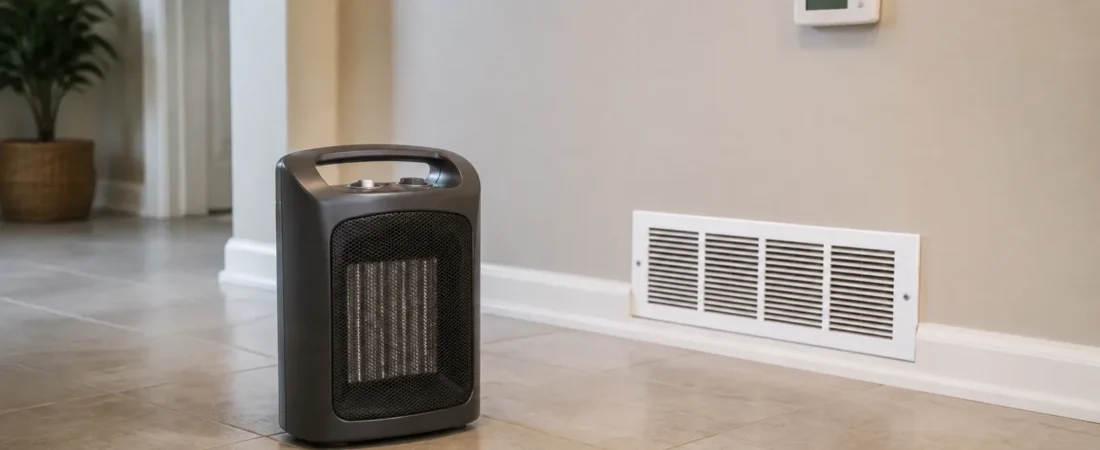
Editorial note: AI-generated illustration of heating options, not a product test or placement diagram. Follow the heater manufacturer’s clearance instructions.