
Your electric bill is usually high for one of three reasons: you used more kilowatt-hours, the price of each kilowatt-hour increased, or the bill covers more days. Extreme weather, longer HVAC run time, electric water heating, new appliances, and corrected meter readings are common causes. Compare average daily kWh and your rate per kWh with the same period last year before blaming one appliance.
Written and reviewed by the DwellWatt Editorial Team. Last reviewed August 30, 2026.
At a glance: Compare kWh per day, current-period charges, and billing days or reading status.
What to Check First
Before unplugging devices or buying efficiency upgrades, compare your current bill with the same month last year.
| What changed? | What it usually means | Best next step |
|---|---|---|
| Average daily use (kWh per day) | Your home used more electricity each day | Check weather, HVAC runtime, water heating, and new appliances |
| Price per kWh | Your supply rate, delivery rate, tier, or plan may have changed | Review the rate section and contact the utility if it is unclear |
| Number of billing days | The bill covers more time | Compare kWh per day instead of total kWh |
| Fees, adjustments, or previous balance | The increase may not be current electricity use | Review each line item and payment history |
| Estimated or corrected reading | A previous estimate may have been reconciled | Compare the previous and current meter-reading status |
The U.S. Energy Information Administration reported a preliminary national residential average of 18.34 cents per kWh for June 2026. That is a benchmark, not your home's rate. Prices vary by state, utility, and plan, so this guide uses $0.18 per kWh only as an example.
Compare the Bill the Right Way
A higher total does not always mean your daily electricity use increased. Use these three calculations:
Average daily use = total kWh ÷ billing days
Average daily bill = current-period electric charges ÷ billing days
Effective all-in cost per kWh = current-period electric charges ÷ total kWh
Use charges for the current electric-service period. Exclude previous balances, late fees, deposits, and unrelated services. The effective all-in cost can include current fixed charges and taxes, so it is useful for comparison but is not necessarily the utility's listed variable rate.
Example: a higher bill with no increase in daily use
Suppose current-period electric charges were $170 for 900 kWh over 30 days. The next period's charges were $205 for 1,050 kWh over 35 days.
| Comparison | Previous bill | Current bill |
|---|---|---|
| Current-period electric charges | $170 | $205 |
| Electricity use | 900 kWh | 1,050 kWh |
| Billing days | 30 | 35 |
| Average daily use | 30 kWh | 30 kWh |
| Effective all-in cost | 18.9¢/kWh | 19.5¢/kWh |
The charges increased about 21%, but the home still used 30 kWh per day. Most of the difference came from five additional billing days, with a smaller change in effective cost. The EIA notes that bills underlying its monthly data can cover 28 to 35 days, which is why daily use is a better comparison than the total alone.
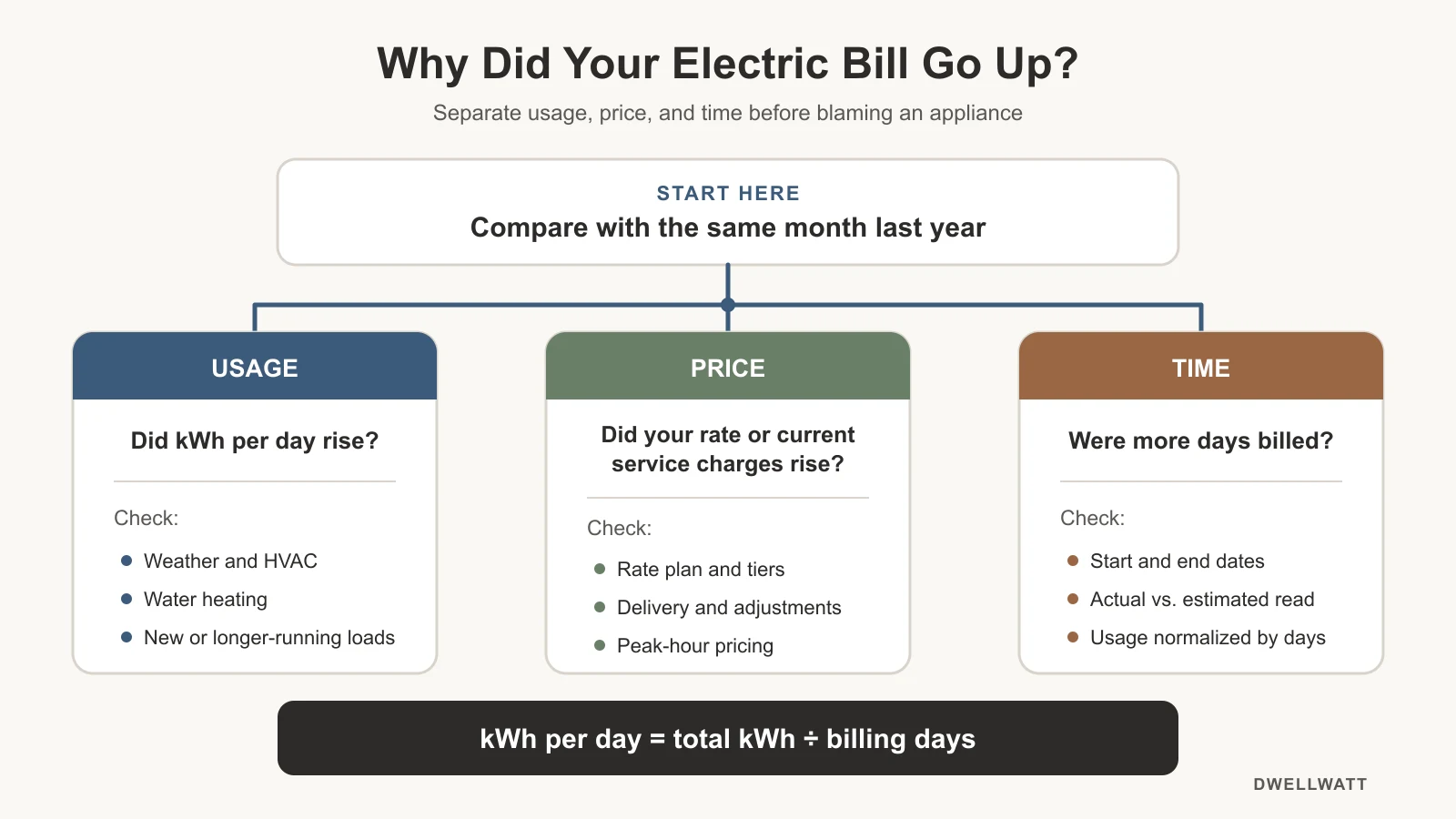
Start with kWh per day, then check current-period price and billing days.
15 Reasons Your Electric Bill Is So High
The causes below are ordered as a practical investigation, not as a claim that every home has the same problem.
1. The weather was much hotter or colder
Heating and cooling respond directly to outdoor temperature. In the EIA's 2020 data, air conditioning represented 19% of U.S. residential site electricity consumption, while space heating and water heating each represented 12%. Your mix may differ. Compare with the same month last year; comparing July with June can mistake normal seasonality for a problem.
2. The thermostat setting or schedule changed
Even a modest thermostat change can increase HVAC runtime during extreme weather. Check for a new hold, a disabled schedule, direct sun, or a nearby draft. The Department of Energy says a 7°F-to-10°F setback for eight hours a day can save up to 10% per year in suitable homes. Results vary, and heat pumps may need a strategy that avoids backup resistance heat.
3. The HVAC system is working harder than it should
A dirty filter, dirty coils, low refrigerant, blocked outdoor equipment, or neglected maintenance can make an air conditioner or heat pump run longer. ENERGY STAR recommends checking filters monthly during heavy-use seasons. If the system runs almost continuously, cannot reach the setting, freezes, leaks, or makes unusual noises, arrange service.
4. Air leaks, insufficient insulation, or leaky ducts are wasting conditioned air
Drafts and duct leaks increase heating and cooling demand. Check accessible weatherstripping and obvious gaps. A professional home energy assessment can use a blower door or infrared camera to find hidden losses. Major air-sealing work must preserve safe ventilation, especially around combustion appliances.
5. Your electricity rate or rate plan changed
Your kWh can stay flat while supply, delivery, fuel-adjustment, tier, or other charges rise. The preliminary U.S. residential average revenue per kWh was 5% higher in June 2026 than in June 2025, but utilities varied widely. Compare both bills; under time-of-use pricing, the same kWh may cost more during peak hours.
6. The billing period was longer
A 35-day bill contains 25% more days than a 28-day bill. At the same daily use, the total can therefore be 25% higher.
Look at the service dates rather than assuming every statement represents exactly one calendar month. Normalize both bills to kWh per day before deciding that your home became less efficient.
7. An estimated reading was corrected
When a utility cannot obtain an actual meter reading, it may estimate usage. If an earlier estimate was too low, a later actual reading can include the difference and make one bill look unusually high.
Look for labels such as actual, estimated, or corrected near the meter reading. If the adjustment is unclear, ask the utility to explain the start reading, end reading, multiplier, and dates.
8. More people are home or the household routine changed
Remote work, school breaks, guests, a new baby, or a family member staying home can increase cooling, heating, hot water, cooking, laundry, computers, and entertainment use at the same time.
Check hourly or daily usage in your utility portal, if available. A higher daytime baseline that began with a schedule change is often more informative than a list of device wattages.
9. You added an EV charger, hot tub, workshop tool, or other large load
EV charging, resistance heat, hot tubs, pumps, and workshop tools can add far more electricity than phone chargers. Estimate input power and runtime. For an EV, use charger data when possible; wall-to-battery losses mean household draw can exceed energy stored in the battery.
10. The electric water heater is using more energy
Longer showers, more laundry, a higher setting, colder incoming water, leaks, or failing components can increase water-heating demand. Check for hot-water leaks and changed usage. DOE commonly recommends 120°F for many homes, but follow manufacturer instructions and household health requirements.
11. A refrigerator or freezer is working overtime
A damaged gasket, dirty condenser area, blocked ventilation, low temperature setting, or hot garage can increase runtime; a second refrigerator is easy to forget. Follow the manual for clearance and cleaning. If food is not staying safely cold or the compressor rarely stops, seek service.
12. Laundry, drying, cooking, or dishwashing increased
Electric dryers, ovens, dishwashers, and hot-water wash cycles add up when used more. Wash full loads, use cooler water when appropriate, clean the dryer lint screen, and never run a dryer with a blocked exhaust vent. Shift flexible loads only if your rate plan rewards off-peak use.
13. A space heater, portable AC, or dehumidifier is running for long periods
Portable climate-control appliances can quietly become major loads. A 1,500-watt space heater drawing full power for four hours a day uses 180 kWh in 30 days—about $32.40 at $0.18 per kWh. Air conditioners and dehumidifiers usually cycle, so nameplate wattage multiplied by scheduled hours may overstate actual consumption.
See our guides to space heater electricity cost and dehumidifier electricity cost for more realistic scenarios.
14. A pool, well, sump, or recirculation pump is running longer
Pumps may follow schedules or activate automatically. A changed timer, leak, clogged filter, heavy rain, or failed control can extend runtime. Review accessible schedules; frequent cycling, pressure loss, unusual noise, or nonstop operation needs professional inspection.
15. Always-on electronics and standby loads added up
Devices can use power while appearing off. Lawrence Berkeley National Laboratory estimates standby use at roughly 5% to 10% of residential electricity, but it rarely explains every sudden spike. Check older electronics and networked equipment. Use plug-in monitors only within their stated limits—never improvise with high-power loads.
What a New Load Can Add in One Month
These examples use $0.18 per kWh. They are transparent calculation scenarios, not claims about typical equipment or actual household behavior.
| Example load | Assumed use | Added electricity in 30 days | Added cost |
|---|---|---|---|
| 1,500 W space heater | 4 hours/day at full power | 180 kWh | $32.40 |
| 1,200 W portable AC | 4 equivalent full-power hours/day | 144 kWh | $25.92 |
| 500 W dehumidifier | 6 equivalent full-power hours/day | 90 kWh | $16.20 |
| 3,000 W electric dryer | 1 hour/day | 90 kWh | $16.20 |
| 7.2 kW EV charging | 2 hours/day | 432 kWh | $77.76 |
| 1,000 W pool pump | 8 hours/day | 240 kWh | $43.20 |
For cycling equipment, equivalent full-power hours equal scheduled hours multiplied by a simplified average load factor. Use this formula with your own numbers:
Estimated monthly cost = watts ÷ 1,000 × equivalent full-power hours per day × days × electricity rate
Our guide to calculating an appliance's electricity cost explains how to find wattage, runtime, duty cycle, and the correct rate.
How to Find the Biggest Electricity User Safely
- Use your utility's interval data. Hourly or 15-minute usage can reveal overnight baseloads, HVAC cycles, EV charging, and sudden changes.
- Match the increase to a date. Look for the day usage changed, then connect it to weather, a new appliance, guests, or maintenance.
- Calculate major loads first. Heating, cooling, water heating, EV charging, dryers, pumps, and portable heaters deserve attention before small chargers.
- Measure only compatible plug-in appliances. Check the monitor's voltage, current, and wattage limits. Do not improvise with high-power or hardwired equipment.
- Change one thing at a time. A one-week test of a schedule or setting provides better evidence than changing ten habits at once.
Do not remove a meter seal or electrical panel cover, touch internal components or service wiring, or disconnect hardwired equipment to investigate a bill.
How to Lower Your Electric Bill
Actions you can take today
- Correct an accidental thermostat hold or schedule change.
- Check the HVAC filter and replace it if dirty and the system instructions permit.
- Reduce unnecessary space-heater, portable-AC, and dehumidifier runtime.
- Fix dripping hot-water faucets and avoid unnecessary hot-water use.
- Shift flexible loads away from peak hours if you are on a time-of-use plan.
- Turn off unneeded lights and electronics, focusing on devices that remain on for many hours.
- Review pool, hot-tub, EV-charging, and pump schedules.
If you rent
Document bill dates, kWh, daily use, meter number, and maintenance symptoms. Check the lease for a dedicated meter, submeter, or allocation method; state rules vary. Report equipment problems in writing. Do not alter the meter or remove an electrical panel cover.
If you own the home
Prioritize HVAC maintenance, ducts, air sealing, insulation, water heating, and scheduled loads. An energy assessment can identify useful upgrades. Do not replace working equipment based on one bill without confirming the cause.
When to Contact the Utility or a Professional
Contact the utility when you cannot explain:
- an estimated or corrected reading;
- a rate, tier, fuel charge, or time-of-use change;
- a meter number that does not match your home;
- missing solar or net-metering credits;
- a major usage increase that is inconsistent with your interval data and routine.
If the utility cannot resolve a billing dispute, your state's public utility commission or consumer protection office may explain the applicable complaint process.
A high bill alone does not prove faulty wiring. If you see smoke, flames, or active arcing, leave the area and call emergency services. For a smell of burning plastic, sparks, hot or discolored outlets, buzzing, or repeated breaker trips, stop using suspect equipment if that can be done safely and contact a qualified electrician. Never attempt an internal electrical inspection.
Frequently Asked Questions
Why did my electric bill suddenly double?
Check whether kWh per day doubled. If so, investigate weather, resistance heat, HVAC, EV or pump schedules, water heating, and new loads. If daily kWh stayed similar, inspect billing days, rates, fees, balances, and reading corrections.
What uses the most electricity in a home?
Air conditioning, electric space heating, and water heating were the largest identified categories in EIA's 2020 data. Your largest load depends on climate, fuels, home, equipment, and behavior; interval data is better for diagnosing one home.
Can a faulty appliance cause a high electric bill?
Yes. Failed controls, blocked airflow, leaks, dirty coils, or worn gaskets can extend runtime. A bill cannot identify the defect; combine usage data with symptoms and use qualified help for hardwired, refrigerant, combustion, or electrical work.
How can I tell if the electric meter is wrong?
Verify the meter number, dates, readings, multiplier, and actual-or-estimated status. If usage still conflicts with your routine, ask the utility to review the account and explain meter testing. Never open or alter the meter.
The Bottom Line
The fastest way to explain a high electric bill is to separate usage, price, and time. Compare kWh per day with the same month last year, then check the rate, billing days, and reading status. If daily use increased, investigate weather and the largest loads before chasing small standby devices. Make safe, measurable changes one at a time, and involve the utility or a qualified professional when the bill or equipment symptoms remain unexplained.
Methodology and Sources
All cost examples use:
- Equivalent full-power hours per day = scheduled hours per day × average load factor
- Energy (kWh) = watts ÷ 1,000 × equivalent full-power hours per day × days
- Cost = energy in kWh × electricity rate
Examples use $0.18 per kWh and 30 days unless stated otherwise. Duty cycles are assumptions, not measurements. Results were calculated before rounding. DwellWatt did not test a specific home, meter, account, or appliance.
Primary references:
- U.S. Energy Information Administration — Electric Power Monthly, Table 5.3
- U.S. Energy Information Administration — Electricity use in homes
- U.S. Energy Information Administration — Factors affecting electricity prices
- U.S. Department of Energy — Consumer Guide to Home Energy Assessments
- ENERGY STAR — Heat and Cool Efficiently
- ENERGY STAR — HVAC Maintenance Checklist
- Lawrence Berkeley National Laboratory — Standby Power
- U.S. Consumer Product Safety Commission — Guide to Home Wiring Hazards
Last reviewed: August 30, 2026. Electricity rates, rate plans, and efficiency guidance can change. Use your current utility bill and equipment instructions.