Written and reviewed by the DwellWatt Editorial Team · Last reviewed August 28, 2026 · How we research and review our guides
Published portable-dehumidifier examples list rated inputs from about 300 to 700 watts. At the June 2026 U.S. residential average electricity price of 18.34 cents per kilowatt-hour (kWh), that works out to roughly $0.06 to $0.13 per equivalent full-load hour.
Runtime matters more than the number on the front of the machine. A 500-watt unit with eight equivalent full-load hours per day costs about $22.01 over 30 days. If it runs at full load around the clock, the estimate rises to $66.02 per month.
Quick answer: To estimate your dehumidifier’s cost, divide its rated watts by 1,000, multiply by equivalent full-load hours, and then multiply by your electricity rate. A plug-in electricity monitor gives a better result because it captures compressor cycling plus fan, control, and standby energy.
Dehumidifier Electricity Cost at a Glance
The estimates below use the latest available national price when this guide was reviewed: $0.1834 per kWh. The U.S. Energy Information Administration reported that price for June 2026 in data released August 26, 2026. The national figure was 5% higher than in June 2025, but your utility rate may be much lower or higher.
| Rated power example | Cost per equivalent full-load hour | 30-day cost at 8 full-load hours/day |
|---|---|---|
| 300 W | $0.06 | $13.20 |
| 500 W | $0.09 | $22.01 |
| 700 W | $0.13 | $30.81 |
These are full-load calculations, not promises about your bill. The fan, compressor, room conditions, setpoint, and control strategy all affect real consumption.
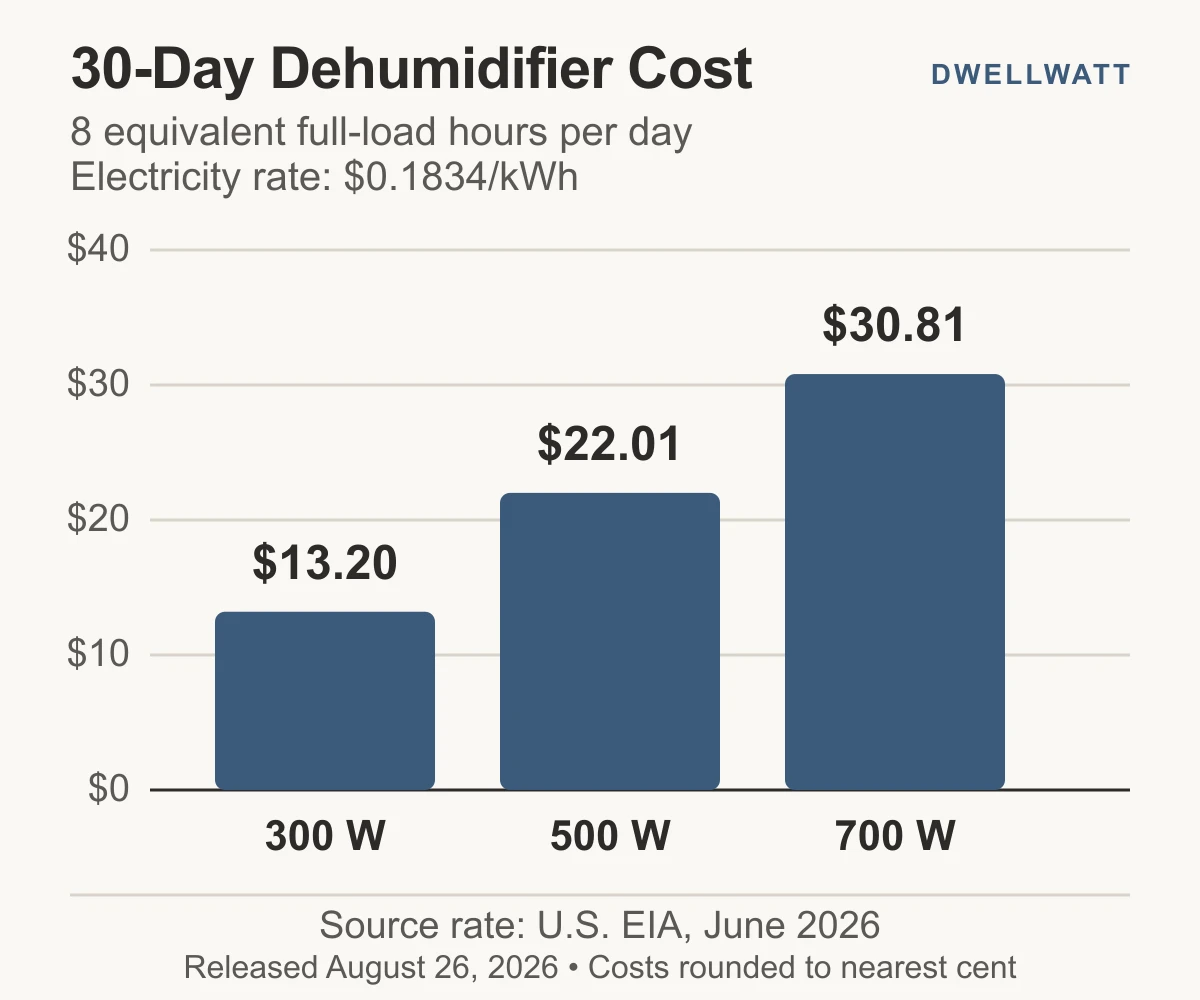
At 18.34 cents per kWh, eight equivalent full-load hours per day cost about $13.20 per month at 300 watts, $22.01 at 500 watts, and $30.81 at 700 watts. Source rate: U.S. EIA, June 2026, released August 26, 2026.
How to Calculate Your Dehumidifier’s Cost
You need three numbers:
- The dehumidifier’s input wattage
- Its equivalent full-load hours per day
- Your variable electricity price in dollars per kWh
Use this formula:
Monthly cost = watts ÷ 1,000 × full-load hours per day × 30 × electricity rate
For example, a 500-watt dehumidifier with eight active hours per day uses:
- 500 watts ÷ 1,000 = 0.5 kilowatts
- 0.5 kW × 8 hours = 4 kWh per day
- 4 kWh × $0.1834 = $0.73 per day
- $0.7336 × 30 days = $22.01 per month
Our guide to calculating the electricity cost of any appliance explains how to find the right rate on your bill.
What “equivalent full-load hours” means
A dehumidifier can remain switched on for 24 hours without drawing its rated input for all 24. Equivalent full-load hours convert the unit’s total measured energy into the number of hours it would have taken to use the same energy at rated input:
Equivalent full-load hours = measured kWh ÷ rated kilowatts
Suppose an electricity monitor records 6 kWh in one day for a 500-watt-rated unit. Divide 6 kWh by 0.5 kW to get 12 equivalent full-load hours. This method includes compressor cycling and any lower-power fan, control, or standby consumption:
0.5 kW × 12 hours × 30 days × $0.1834 = $33.01 per month
Without a meter, scheduled hours near full draw can provide a planning estimate, but they do not measure the unit’s exact duty cycle.
Cost of a 500-Watt Dehumidifier by Runtime
| Equivalent full-load time | Daily cost | 30-day cost |
|---|---|---|
| 4 hours/day | $0.37 | $11.00 |
| 8 hours/day | $0.73 | $22.01 |
| 12 hours/day | $1.10 | $33.01 |
| 24 hours/day | $2.20 | $66.02 |
If a correctly sized unit runs continuously after the initial drying period, look for an ongoing moisture source.
How Many Watts Does a Dehumidifier Use?
There is no universal wattage. Published specifications illustrate the range: a Midea manual lists 295, 495, and 690 watts for several older models, while a GE product page for a discontinued 50-pint portable model lists 530 watts. These examples are not a rule for every unit of the same capacity.
Check the rating label or manual for input watts. For a real-world number, use a plug-in electricity monitor rated for the load and record kWh for several days so the result includes compressor cycling.
Be careful when comparing old and new pint ratings
The U.S. Department of Energy changed the test procedure, and capacity labels shifted starting in 2020. ENERGY STAR explains that an older 50-pint unit may be roughly comparable to a newer 30-pint rating, while an older 70-pint rating may correspond to roughly 40–45 pints. Compare the test era, wattage, and efficiency—not only the pint number.
Why Your Actual Electricity Use Changes
- Humidity and setpoint: The farther the room is from the target, the longer the compressor works. The EPA and ENERGY STAR generally describe 30% to 50% relative humidity as an appropriate range. Near 50% is a practical starting point for many damp spaces, subject to climate and building conditions.
- Moisture sources: Foundation seepage, plumbing leaks, damp crawl spaces, unvented dryers, and humid outdoor air can add moisture faster than the machine removes it. Fixing the source can reduce both damage risk and runtime.
- Temperature: Compressor models generally remove less water in cool conditions and may need defrost cycles. Follow the stated operating-temperature range.
- Airflow and maintenance: A dirty filter, blocked intake, or kinked drain hose can hurt performance. Maintain the clearances and cleaning schedule in the manual.
Efficiency: IEF and ENERGY STAR
The Integrated Energy Factor, or IEF, measures how many liters of water a dehumidifier removes per kWh under standardized conditions. Higher is better. IEF is more useful than wattage alone because a larger unit may draw more power but finish sooner, while an undersized one may run continuously.
The current ENERGY STAR Version 6.0 criteria took effect October 1, 2025. ENERGY STAR says a certified model uses about 20% less energy than a comparable conventional unit. If comparable usage costs $22 per month, 20% represents about $4.40.
Actual savings vary. Compare the purchase price and standardized annual kWh in the ENERGY STAR database; those test values help compare models but do not guarantee home usage.
How to Lower Dehumidifier Running Costs
- Use a realistic target. Start near 50% RH when appropriate rather than forcing the lowest setting.
- Repair moisture sources. Address leaks, drainage problems, damp foundations, and unvented moisture.
- Choose the right capacity. An undersized unit may run constantly.
- Keep the space reasonably closed. Open windows and doors can invite humid outdoor air.
- Protect airflow. Clean the filter and follow the manufacturer’s clearance instructions.
- Measure before replacing. Record kWh over representative days and compare the cost with a new model’s standardized annual consumption.
Dehumidifier vs. Air Conditioner for Humidity
Both can condense water, but they do different jobs. An air conditioner moves heat outdoors while cooling; a portable dehumidifier releases its electrical input and the heat produced by condensation into the room. It can warm the space, but it is not meant to replace a heater. Our space-heater electricity cost guide shows how its power draw compares with a typical 1,500-watt heating load. Use a dehumidifier when moisture is the main problem and extra cooling is unnecessary. When both temperature and humidity are high, air conditioning may be more appropriate.
Check Older Dehumidifiers for Recalls
Before operating an older or secondhand unit, search its complete model number and date code in the CPSC recall database. The agency continues to warn about recalled dehumidifiers associated with overheating and fires, including models sold under multiple brand names.
If the unit is recalled, follow the official remedy and stop using it as directed. Keep the cord and plug undamaged, maintain required clearances, and follow the manual.
Frequently Asked Questions
How much does a 50-pint dehumidifier cost to run?
Use its actual wattage rather than the pint rating. A 500-watt example costs about $0.09 per active hour, $0.73 for eight active hours, and $22.01 for 30 days at eight active hours per day using $0.1834/kWh. A 530-watt model under the same assumptions would cost about $23.33 per month.
Does a dehumidifier use electricity when the compressor is off?
It can. The fan, controls, display, or standby electronics may continue drawing power. A plug-in electricity monitor captures those loads as well as compressor cycling.
Is it expensive to run a dehumidifier 24/7?
It can be. A 500-watt unit at full power continuously would use 360 kWh in 30 days and cost about $66.02 at the national example rate. Cycling may reduce that total. Nonstop operation can also indicate a low setpoint, undersizing, poor airflow, or unresolved moisture.
Bottom Line
A dehumidifier can be a modest expense or a noticeable part of the electric bill. At the June 2026 national example rate, a 500-watt unit using the equivalent of eight full-load hours per day costs about $22 per month; continuous full-load operation would cost about $66. Use the rating label for a planning estimate and measured kWh for a better answer. The largest savings usually come from choosing a sensible humidity target, fixing leaks or other moisture sources, sizing the unit correctly, and maintaining airflow. Before using an older or secondhand machine, check its model number against current CPSC recalls.
Next step
Use our appliance electricity cost guide to substitute your dehumidifier’s exact wattage and local rate. You can also compare this continuous-use appliance with the estimates in our space heater electricity cost guide.
Methodology and Sources
All cost estimates use:
- Energy = watts ÷ 1,000 × equivalent full-load hours
- Cost = energy in kWh × electricity rate
Monthly examples assume 30 days. Calculations used unrounded figures and were rounded only for display. The $0.1834/kWh reference is the EIA’s preliminary U.S. residential average for June 2026, released August 26, 2026. It is a national benchmark, not a substitute for the reader’s utility rate.
DwellWatt used published specifications and standardized data; it did not claim hands-on or laboratory testing of a particular dehumidifier.
Primary references:
- U.S. Energy Information Administration — June 2026 electricity summary
- ENERGY STAR — dehumidifier guidance and sizing
- ENERGY STAR — current efficiency criteria
- ENERGY STAR — testing and capacity changes
- ENERGY STAR — certified dehumidifier product database
- U.S. EPA — indoor humidity guidance
- U.S. Consumer Product Safety Commission — dehumidifier recalls
- GE Appliances — example 50-pint model specifications
- Midea — example dehumidifier manual
Last reviewed: August 28, 2026. Electricity prices, product specifications, efficiency criteria, and recall information can change.