
By DwellWatt Editorial Team · Sources reviewed September 6, 2026
A refrigerator does not draw the same number of watts all day. The compressor, fans, and defrost system use power at different times. For your electricity bill, the most useful number is kilowatt-hours (kWh), not a single wattage reading.
Here is a practical starting point: a refrigerator labeled 400 kWh per year works out to about 1.10 kWh per day and $6 per average month at $0.18/kWh. Those are calculated estimates, not a measurement of your refrigerator. Your model, kitchen conditions, and electricity rate can change the result.
If you want to size backup power, you also need the appliance’s running and starting requirements. This guide explains which number to use for each question, then shows how to estimate what your refrigerator adds to the bill.
Refrigerator watts: which number are you looking at?
GE Appliances gives a broad figure of 300–800 watts while running in its refrigerator FAQ. Treat that as general guidance from one manufacturer, not a specification for every fridge. Check your own model’s documentation, especially for a compact or variable-speed refrigerator.
Three different numbers can describe the same appliance:
- Running power: the watts it draws in a particular operating state. That reading can change as components switch on or off.
- Starting demand: the brief extra power a compressor may need when it starts. This matters when checking whether a generator or power station can operate the appliance.
- Average power over time: total energy use divided by elapsed time, including quieter periods. This is useful for understanding consumption, but it is not the wattage needed to start the refrigerator.
For the 400-kWh-per-year example, the equivalent year-round average is about 46 watts: 400 × 1,000 ÷ 8,760 hours. That does not mean a 46-watt power source could run it.
GE’s electrical guidance explains why starting demand and model-specific requirements matter. Do not use a yearly average to choose backup equipment.
How much electricity does a refrigerator use per day?
Find the estimated yearly electricity use on the yellow EnergyGuide label, usually expressed in kWh. If the label is missing, look for the exact model’s EnergyGuide or specification sheet on the manufacturer’s website.
Use these formulas:
Daily kWh estimate = annual kWh ÷ 365
Average monthly kWh estimate = annual kWh ÷ 12
The table below uses three documented models to show how the calculation works. These are examples across different sizes, not category averages, purchase recommendations, or results from DwellWatt product testing.
On small screens, scroll the table sideways to see all columns.
| Documented example | Capacity | Listed annual use | Calculated daily use | Average monthly cost at $0.18/kWh |
|---|---|---|---|---|
| Frigidaire EFR115-C-RED-COM compact refrigerator | 1.6 cu. ft. | 158 kWh | 0.43 kWh | $2.37 |
| Criterion 18TMF-W top-freezer refrigerator | 18.0 cu. ft. | 363 kWh | 0.99 kWh | $5.45 |
| LG LRFWS2906S French-door refrigerator | 29.0 cu. ft. | 653 kWh | 1.79 kWh | $9.80 |
Sources: ENERGY STAR’s Frigidaire listing, ENERGY STAR’s Criterion record, and LG’s U.S. specification sheet. Specifications were checked September 6, 2026. Model availability and revisions can change.
The smaller appliance has a lower total estimate here, but it also provides far less storage. Compare models that meet the same household need before deciding which is the better choice.
The annual figure is based on standardized testing, not measurements in your kitchen. A hot week in your kitchen may use more energy than the daily average above. These figures also use an average month of one-twelfth of a year, rather than treating every month as exactly 30 days.
Calculate your refrigerator’s monthly electricity cost
Use the label’s kWh figure with your own electricity price:
Average monthly cost = annual kWh ÷ 12 × price per kWh
For a 400-kWh-per-year refrigerator at $0.18/kWh:
400 ÷ 12 × $0.18 = $6.00 per average month
The estimated yearly electricity cost is 400 × $0.18 = $72. The rate here is an illustrative assumption, not a claim about the current U.S. average.
If your bill lists cents per kWh, convert cents to dollars first: 18 cents becomes $0.18. Include the usage-based supply and delivery charges that apply to each additional kWh. A fixed monthly customer charge normally remains even if the refrigerator uses less electricity.
The Federal Trade Commission explains that the dollar amount printed on an EnergyGuide label uses assumptions about energy prices and usage. It is not a promise of what you will pay. Recalculating from kWh lets you use a rate that fits your bill.
For a time-of-use plan, this simple formula is an approximation. The cost depends on when the fridge uses electricity and the rates in those hours. A whole-bill average can be a rough shortcut, but it is less precise for estimating the savings from one appliance.
The same refrigerator can cost more at a different rate
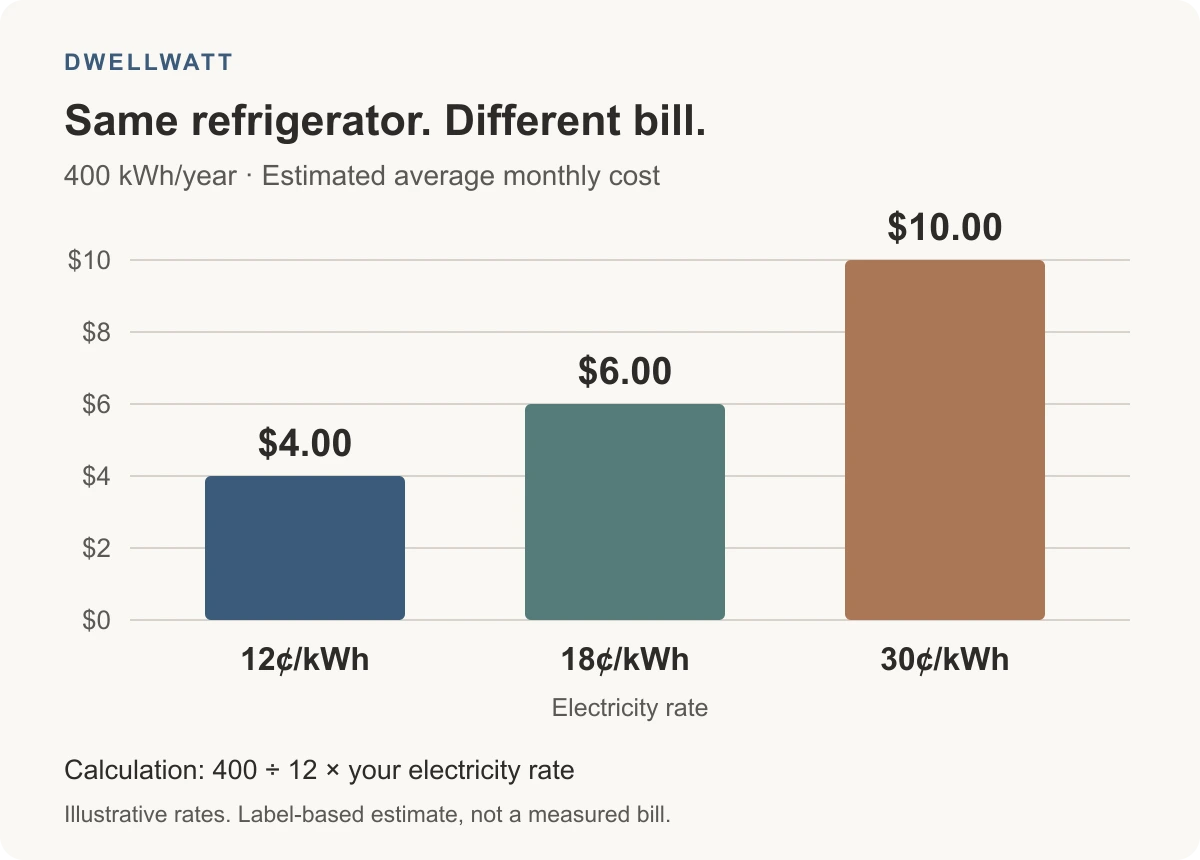
For the same hypothetical 400-kWh-per-year refrigerator, the average monthly estimate is $4.00 at $0.12/kWh, $6.00 at $0.18/kWh, and $10.00 at $0.30/kWh.
View the cost chart at full size (opens in a new tab).
Calculated examples: annual use ÷ 12 × electricity rate. These are hypothetical rates and label-based estimates, not measured household bills.
If the appliance’s kWh use has stayed the same but your rate increased, the refrigerator can cost more without developing a fault. Our guide to a high electric bill helps separate higher prices, higher usage, and a longer billing period.
Why multiplying the rated watts by 24 can mislead you
Suppose a plate lists 300 watts. Multiplying 300 × 24 ÷ 1,000 gives 7.2 kWh per day, but that assumes a steady 300-watt draw for every hour. The number is only meaningful if that assumption matches actual operation.
A refrigerator’s cooling and defrost cycles make that shortcut unreliable. Variable-speed equipment can also run for long periods at changing power levels. Do not substitute a universal rule such as “all refrigerators run eight hours a day.”
GE’s normal cycle-time guidance notes that some modern refrigerators run for much of the day. Long runtime by itself does not establish excessive energy use. Check temperature and total kWh before concluding that the appliance is faulty.
For the bill, prioritize the EnergyGuide estimate or a suitable measurement of accumulated kWh. For electrical supply requirements, use the appliance’s installation instructions and manufacturer specifications.
How to check your actual refrigerator energy use
A measurement is especially useful if the refrigerator is old, kept in a garage, or seems to have changed its behavior. A one-minute wattage reading will not capture the full pattern.
If your appliance instructions permit an appropriate plug-in energy meter, choose one explicitly rated for the appliance’s voltage, current, and motor load. Follow both manuals. If the outlet is inaccessible, the connection is hardwired, or compatibility is unclear, ask a qualified technician for help instead of improvising a connection.
Record the meter’s total kWh and elapsed time, not just the watts on screen. Measuring several representative days gives you a more useful starting point than one quiet hour. Keep your usual settings and door-opening routine, and note unusually hot weather or a large grocery load.
Here is an illustrative reading:
- Recorded use: 8.4 kWh over seven complete days.
- Daily average: 8.4 ÷ 7 = 1.2 kWh.
- Cost for a 30-day period at $0.18/kWh: 1.2 × 30 × $0.18 = $6.48.
That result estimates a similar 30-day period; it does not establish the refrigerator’s annual consumption. Repeat the check in substantially different conditions if you need a better year-round estimate.
Do not turn a stocked refrigerator off overnight to cut its electricity use. Maintain food-safe temperatures throughout the day.
What can make refrigerator consumption increase?
Start with changes you can observe: warmer surroundings, a door that no longer closes properly, blocked ventilation, a colder setting, or increased use. Compare your results under similar conditions before deciding that a repair is needed.
Use this short checklist:
- Check the temperature with an appliance thermometer. The FDA recommends keeping the refrigerator at 40°F or below and the freezer at 0°F. Avoid choosing a warmer setting just to lower the bill.
- Look at the door seals. Check for visible damage or gaps and for food or containers preventing the door from closing.
- Check the installation clearances. Follow your model’s manual so air can circulate around the appliance. A garage installation also needs to meet the manufacturer’s ambient-temperature limits.
- Follow the maintenance instructions. If the manufacturer calls for cleaning accessible condenser coils, follow its safe procedure. Not every model has user-serviceable coils.
ENERGY STAR’s refrigerator guidance supports checking seals, ventilation, placement near heat sources, and appropriate maintenance. If the refrigerator cannot hold a safe temperature or its energy use changes sharply without an obvious explanation, arrange a service check.
Is replacing an old refrigerator worth it for the energy savings?
Calculate the potential savings before making a purchase. “More efficient” does not automatically mean that a new appliance will pay for itself quickly.
Suppose, purely as an example, your old refrigerator uses 800 kWh per year and a suitable replacement is rated at 400 kWh per year. The estimated reduction is 400 kWh. At $0.18/kWh, that is $72 per year.
If the net replacement cost were $900, the simple energy-only payback would be $900 ÷ $72 = 12.5 years. This ignores future rates, financing, maintenance, and differences between label estimates and household use. Repair needs, reliability, storage, and food safety may matter more than energy savings alone.
Also consider what happens to the old unit. Moving it to the garage and continuing to run it adds another appliance to your household use, so the expected replacement savings will not follow from that plan.
Quick answers
Does a mini fridge use less electricity than a full-size refrigerator?
It can use fewer total kWh, as the examples above show, but the difference depends on the exact models. A mini fridge also holds much less. Use annual kWh to compare operating cost and capacity to check whether it meets your needs.
Does a refrigerator use electricity when the compressor is off?
Other components may still draw power, depending on the model and operating cycle. That is another reason to use accumulated kWh rather than assuming that “compressor off” always means zero consumption.
Can a 1,000-watt power station run my refrigerator?
The watt rating alone cannot answer that. Check continuous output, surge capability, the refrigerator’s requirements, and the manufacturer’s compatibility guidance. Battery capacity in watt-hours affects runtime, and usable energy is lower after conversion losses. The 46-watt annual average in this guide is not a sizing specification.
What should I do first?
Find your refrigerator’s annual kWh figure and the usage-based rate on your bill. Calculate the monthly estimate, then investigate further if measured consumption or cooling performance gives you a reason to do so.
For the next appliance on your list, use our step-by-step appliance electricity cost guide.
How this guide was prepared: DwellWatt reviewed the linked manufacturer and government sources and calculated the examples shown. We did not test these refrigerators. Rates and replacement costs identified as examples are hypothetical. See our editorial policy for our approach to sources and corrections. Cover image: AI-generated editorial illustration. Chart: DwellWatt calculations.